Skip to main contentSkip to content

Better Robots.txtThe WordPress plugin for robots.txt, AI crawlers, and llms.txt

Control which bots can crawl, train, or quote your content. Guided setup, per-crawler rules, and machine-readable policy — no manual editing required.

Better Robots.txt logo
FreeProPremiumSEO • AI visibility • machine-readable policy • WordPress
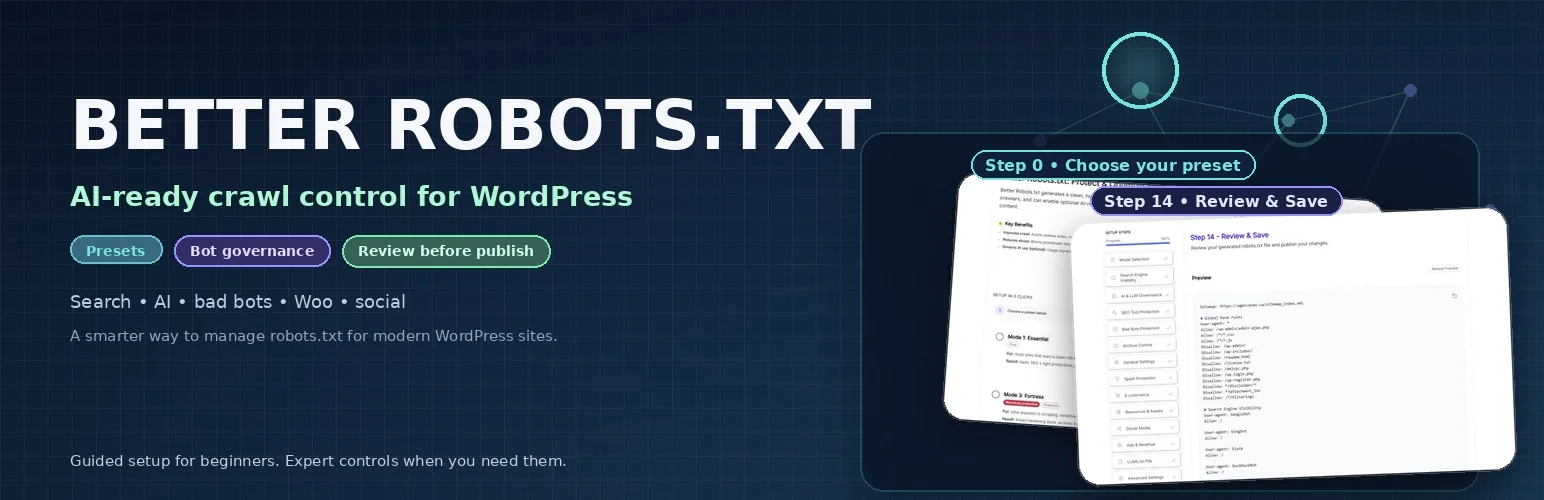
Better Robots.txt interface showing guided presets and policy controls

⚡ Try the free Crawl Governance Audit first

Wondering where your site stands? Run a 30-second audit of your robots.txt, llms.txt, and posture toward 20+ AI crawlers — the same audit we use internally, scored across a 30-rule, six-block framework covering presence, search baseline, AI crawler coverage, machine-readable signals, WordPress hygiene, and resource accessibility. Available in 8 languages, no sign-up.

Audit your site → Learn how the AI checker works →

What the plugin does

Better Robots.txt gives WordPress teams a guided way to control which bots can access their content — and how.

Instead of editing a raw text field, you select a preset, adjust per-crawler rules, and publish a clean robots.txt with optional llms.txt and AI usage signals. The plugin handles:

  • robots.txt generation with guided presets (Essential, AI-First, Fortress, Custom);
  • per-crawler rules for GPTBot, ClaudeBot, Google-Extended, Applebot, and more;
  • llms.txt publishing to tell AI systems what your site offers;
  • crawl waste reduction by blocking bad bots and unnecessary paths;
  • AI usage policy so crawlers know your stance on training, quoting, and indexing.

Built for AI visibility

Use the plugin as part of a larger visibility stack that includes source pages, snippet governance, logs, and measurement.

Built for WordPress reality

Presets, guided explanations, and a final review step keep the workflow usable even when teams are not robots.txt specialists.

Built for machine governance

Search engines, AI bots, archive services, user-triggered agents, SEO tools, and bad bots should not all inherit the same policy by default.

Built for operational teams

The goal is not theory for theory’s sake. The goal is a publishable policy that remains understandable six months later.

New audit documentation cluster

The free checker now has a dedicated documentation layer. Start with the pillar page, then move into the specific surfaces the audit evaluates.

Robots.txt checker for AI crawlers

The main guide to the scan, its score, its crawler categories, and the fix path for WordPress.

Better Robots vs traditional validators

Clarifies when to use Better Robots.txt, Google Search Console, Screaming Frog, or a URL-level robots.txt validator.

WordPress AI robots.txt checker

The conversion path from audit to Better Robots.txt configuration, preview, and re-audit.

AI crawler coverage checker

How the scan evaluates GPTBot, OAI-SearchBot, ClaudeBot, Claude-SearchBot, Google-Extended, PerplexityBot, and Applebot-Extended.

llms.txt checker

How the audit treats llms.txt as machine guidance without overclaiming enforcement or ranking guarantees.

The strategic hub pages

These pages define the category Better Robots.txt now wants to own.

AI visibility

The main hub for modern discoverability, source-page design, machine-readable policy, and governance coherence.

AI search SEO

Why AI visibility is now a core SEO practice instead of a side experiment or trend label.

AI visibility controls

The practical matrix of robots.txt, meta robots, X-Robots-Tag, snippet controls, llms.txt, public policy, logs, and edge controls.

Measure AI visibility

The KPI stack for search performance, crawler behavior, surfaced URLs, referrals, and business outcomes.

Practical vendor paths

Most users do not search for "crawl governance". They search for a platform or a concrete outcome.

Product routes that this site now covers

Agentic readiness for WordPress

Crawler governance vs agentic readiness

The layer map that separates crawl access, post-crawl usage, interpretive citation, browser-agent operability, and downstream AI visibility.

Content-Signal in robots.txt

How search, ai-input, and ai-train express post-crawl usage preferences without replacing Allow or Disallow.

Agentic readiness for WordPress

The product bridge between crawl governance, machine-readable guidance, source-page quality, and agent interaction limits.

Lighthouse Agentic Browsing

How to read Chrome Lighthouse’s experimental Agentic Browsing checks without turning them into SEO ranking claims.

llms.txt and Lighthouse audit

Why llms.txt matters as machine orientation while remaining distinct from crawler enforcement and Search ranking.

Agentic readiness checklist

A practical WordPress checklist covering robots.txt, AI crawlers, llms.txt, governance files, source pages, accessibility, stability, and logs.

Better Robots.txt is a layer, not the whole strategy

A healthy AI visibility program still needs indexable source pages, strong internal linking, coherent snippets, and measurement. Better Robots.txt matters because it stabilizes the crawl and machine-governance layer those other efforts depend on.

Choose your operating model

Essential

Best for: sites that mainly need a cleaner robots.txt and safer defaults.

AI-First

Best for: publishers and content-heavy sites that want a clearer AI usage posture without shutting down discovery.

Fortress

Best for: protection-first sites that care more about archive, scraping, and bot boundaries.

Custom

Best for: advanced teams that want to design the policy surface module by module.

Watch the workflow

Better Robots.txt demo video thumbnail

Start here