
LinkedIn B2B AI visibility: from Insight Tag to crawl governance
You installed the LinkedIn Insight Tag because your B2B website needs to be measurable.
That is a good first layer. It helps connect LinkedIn activity, landing pages, retargeting, and conversion paths. But measurement is not the whole system anymore. The pages you promote from LinkedIn also need to be crawlable, understandable, and governed for search engines and AI-related crawlers.
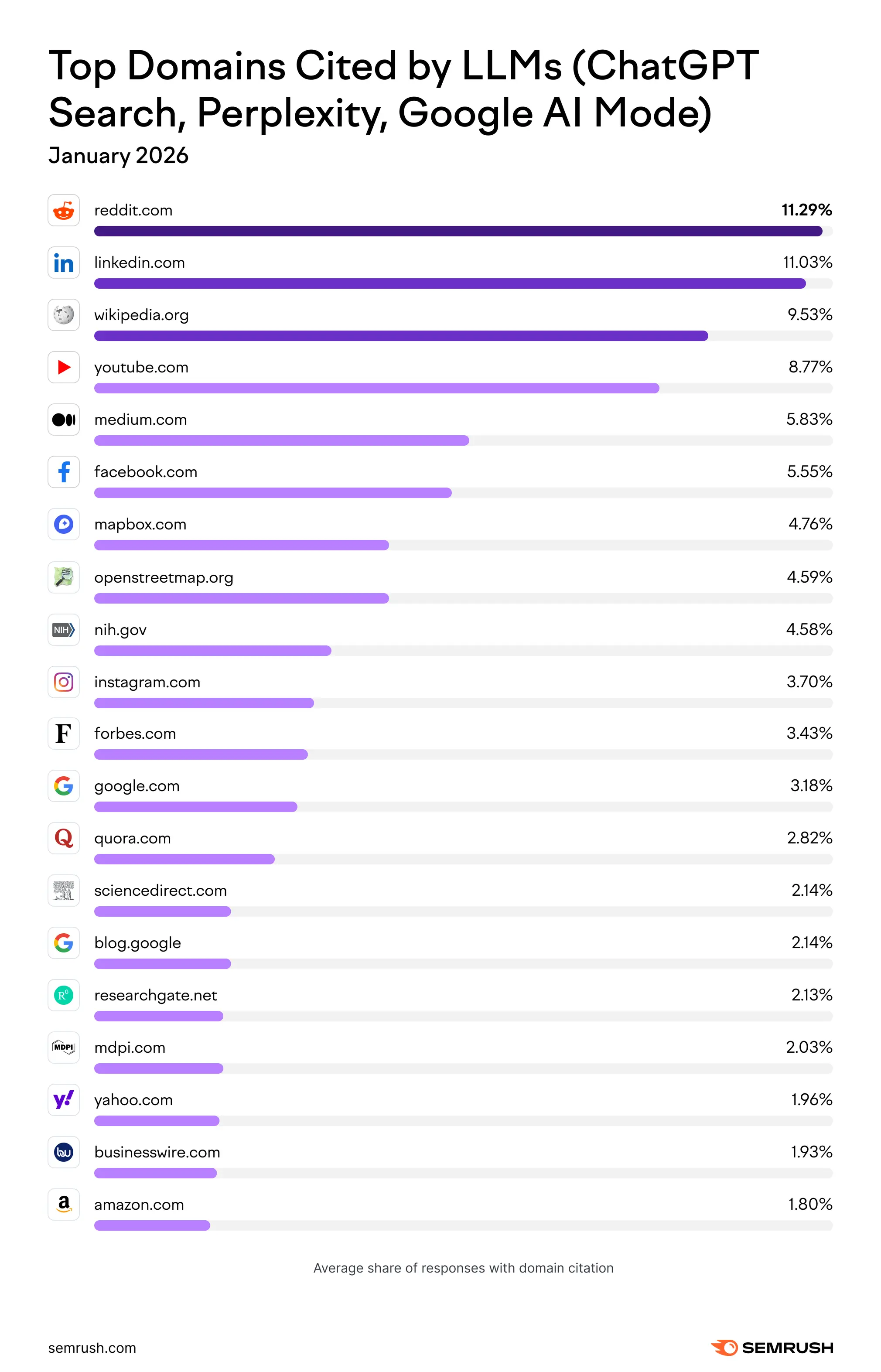
Source: Semrush LinkedIn AI visibility study, published March 10, 2026. Semrush analyzed LinkedIn URLs cited by ChatGPT Search, Google AI Mode, and Perplexity. The chart is used here as market context, not as a claim that Better Robots.txt can create AI citations.
Why this matters for a B2B site
A LinkedIn tracking setup usually signals a practical B2B goal:
- you expect LinkedIn visitors to land on your website;
- you want to measure campaigns, audiences, or conversion paths;
- you care about how the company is understood beyond one social profile;
- you are probably sending visitors to service pages, demo pages, contact pages, case studies, or thought-leadership content.
Those same pages are also the pages that search and AI-assisted systems may crawl, summarize, compare, or ignore. If the site is technically ambiguous, the tracking layer can tell you what happened after the visit, but it cannot fix what machines understood before the visit.
What the Semrush study changes
Semrush reports that LinkedIn ranked as the second most cited domain in its January 2026 AI search dataset, with LinkedIn appearing in about 11% of AI responses on average across ChatGPT Search, Google AI Mode, and Perplexity.
That does not mean every LinkedIn post, company page, or landing page will be cited. It means LinkedIn is now part of how B2B entities, people, categories, and claims can be interpreted by AI search systems.
The practical consequence is simple:
If LinkedIn helps shape the market context around your company, your website should not publish a vague machine-readable posture.
Your LinkedIn layer and your website layer should reinforce each other:
- LinkedIn explains who you are and why the market should care;
- your website gives the canonical pages, offers, policies, and conversion paths;
- your crawl policy tells machines which public surfaces are open, restricted, guided, or intentionally out of scope.
What to check before sending more LinkedIn traffic
Robots.txt clarity
Your robots.txt should not be a generic leftover. It should preserve search access, expose the sitemap, reduce WordPress crawl waste, and make AI crawler choices explicit where useful.
AI crawler coverage
GPTBot, OAI-SearchBot, ClaudeBot, Claude-SearchBot, Google-Extended, PerplexityBot, Applebot-Extended, and other crawler families do not all represent the same purpose.
Landing page readability
A B2B page should state its category, audience, offer, proof, and next step clearly. Crawlers and answer systems are not helped by vague positioning.
Machine-readable guidance
Files such as llms.txt, governance references, sitemap declarations, and explicit usage policy signals help clarify intent. They do not replace real content quality.
What the free audit does
The Better Robots.txt audit checks the public posture of a site from the outside. It looks at:
- whether
robots.txtexists and is reachable; - whether search crawlers remain able to access public pages;
- whether AI crawler families are addressed explicitly;
- whether the sitemap is exposed;
- whether WordPress crawl hygiene problems are visible;
- whether
llms.txtor governance files are present; - whether public resources needed for interpretation are blocked.
It does not require installing a plugin first.
Where Better Robots.txt fits
Better Robots.txt does not promise AI rankings, AI citations, or crawler obedience.
Its job is narrower and more useful: it helps WordPress teams publish a cleaner crawler policy from inside WordPress, without manually editing server files.
Use it when the audit shows that the site needs:
- a clearer
robots.txt; - better sitemap exposure;
- safer WordPress crawl defaults;
- explicit AI crawler rules;
- a manageable way to adjust policy as crawler ecosystems change.
Recommended path for LinkedIn B2B teams
- Keep the LinkedIn Insight Tag working.
- Run the free AI crawl audit.
- Fix obvious
robots.txt, sitemap, and WordPress hygiene issues. - Decide which AI crawler families should be allowed, restricted, or explicitly addressed.
- Keep LinkedIn pages, company profiles, and website landing pages semantically consistent.
- Measure downstream outcomes separately: referrals, surfaced URLs, leads, and real conversions.